Thursday, 26 November 2009

Inner Marsh Farm: Reserve 51

I received the latest letter from the RPSB this morning and reading through one of the leaflets I noticed an interesting omission in the list of northern reserves: Inner Marsh Farm.

Inner Marsh farm used to be absent from all RSPB literature as when the reserve was originally granted planning permission, the nimbys added the proviso that it essentially remained secret in order to prevent too many visitors - and therefore traffic – from ruining their Daily Mailesque rural idyll.

It therefore had a similar status to the US Government’s infamous secret military airbase – the so-called ‘Area 51’- in the Nevada desert. I even remember my first ever visit before the recent period of glasnost: after receiving instruction from Richard Smith, I was blindfolded and then bundled in a windowless van before being driven to the location by some blokes in black suits.

Thankfully times have now changed and despite the runways on the above map of Area 51 looking worryingly similar to the plans for the expanded reserve, I fully expected to be granted access this afternoon.

In the period before evening, on a clear and still day, when the sun sits just above the Clwydian Range escarpment the light at IMF can be perfect giving you wonderful views of the assorted wetland birds.

Tonight was one such night, and one that was very much welcome after the recent spate of rain and gales. After two weeks of shivering behind the causeway, the wildfowl and waders were back on number two pool.

The highlight was cracking views of Spotted Redshank feeding slap bang in front of the hide with a Reeve and a Ruff for company and also, momentarily, a Water Rail.

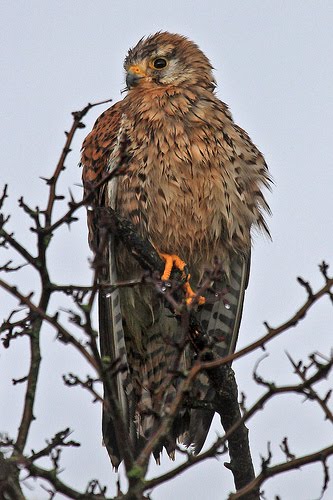
Sadly the light soon faded, but not before I watched a couple of Kestrels having a minor territorial dispute and a Buzzard lumbering into its roost at the top of a tree.

Until later.

Wednesday, 25 November 2009

Gowy Meadows

With the rain clearing up and the wind easing I nipped down to Gowy Meadows CWT at dusk today. It is a reserve – like Nikolai Valuev - that consistently punches below its weight.

It looks absolutely perfect for owls; lots of lovely rough grassland, voles galore and even lots of pukka posts to perch on. If you are a Short-eared Owl then surely this is the over-wintering des res.

There is one tiny problem though in that the owls seem to disagree. Numerous evening visits over the past few winters have produced nada – not even a Barn Owl that I know for certain breed at the nearby village of Stoak.

This evening was no different – the Kestrels having the run of the place yet again – although there was a surprise in the form of a Kingfisher perched at the foot of the Shell Road bridge.

Hopefully the bird will stay in area, although it is more than likely just taking advantage of a temporarily swollen section of the River Gowy.

In other news it was good to hear that the government is planning to plant an extra 4% of woodland – native deciduous too, not dreadful conifer plantations. Link: http://news.bbc.co.uk/1/hi/uk/8377827.stm

Henry David Throreau would have approved I think.

Until later.

Tuesday, 24 November 2009

Designer Stubble

I had a walk around Greenfield today, starting from the quaint little harbour and then up to the abandoned rust bucket, before doubling back.

With it being at the weak point of the tidal cycle, the water was up against the sea wall despite it being low tide. The usual crowd were roosting on the rocks: Redshank, Curlew, Turnstone and a few Oystercatchers whose discarded mussel and cockle shells crunched under my feet.

The flooded pastures had attracted a good herd of local curlew with around ninety birds feeding in the field next to the rather pungent sewage works. A flock of around five hundred Starlings busied around their feet, whilst a pair of aerodynamically savvy Grey Herons sat squat in the corner of the field monitoring the proceedings.

Just before I made a run for the car to avoid the rain, I had a quick scan of a small stubble field adjacent to the sewage treatment plant. Two Pied Wags were all I could see initially, but they were soon joined by four small passerines – Twite! Great to see an actual flock – albeit modest - rather than the singles I have been fed so far this autumn.

There was just time to nip over the fence at the rifle range embankment on my way back to Chester, but the weather was getting quite grim really and a female Peregrine going hell for leather in pursuit of a Woodpigeon was the best I could manage, plus three Goldeneye and a Pochard on the pool.

Until later.

Monday, 23 November 2009

Les Miserables

I must confess that John Ruskin is testing my patience a little now! He’s right though, there is really no such thing as bad weather, it’s the same weather day after day that is the real problem – it becomes tedious, rain or shine.

The scene on Burton marsh this morning was rather sodden with the resident Kestrels looking like gloom personified - praying I’m sure for some better hunting conditions. The owls must be enduring tough times too - it can be no fun having saturated feathers.

On the other hand, some of the wading birds – Curlew and Snipe for example – must be thriving in the damp conditions; the muddy earth being perfect for their long and probing bills.

The rainfall has also topped up all the flashes on the marsh which looks like being a boon for the over-wintering wildfowl – at the end of September most were bone dry. Egrets too must be relishing the prospect of investigating all the new pools.

With Becks and I drenched to the skin and feeling rather fed-up it was difficult to focus on the birds today, both in terms of concentration and in a littoral sense too – I could not keep my lens’ clear for more than twenty seconds.

Nevertheless, I did manage to find what I am fairly certain was a female Merlin, but given the condition of my optical equipment it could have equally been part of a fence post or a speck of dirt!

Maybe this is just as well, as I can refocus my attention on reading the new North-East Wales Bird Report for 2008. It has a picture of a GS Woodpecker on the front and you can pick-up a copy at Inner Marsh Farm for the modest sum of a fiver.

The publication is the work of the hitherto unknown to me Clwyd Bird Recording Group and covers the counties of Flintshire and Denbighshire. No fewer than four hundred people have submitted sightings to the report, with some chap called Anon Birdguides the most prolific contributor of all – he must get out more than me!

Seriously though, it must have taken a Herculean effort to collect and collate all the available data. Bird recording seems to be an extremely disparate activity nowadays with some sightings made available electronically in a matter of seconds whilst others are received some time later via more traditional methods such as paper submissions.

Many must go unrecorded too; for example, surely more than four Cuckoo’s must have been heard or sighted in Flintshire during 2008? I personally have heard two this year at Cilcain and Coed Talon – both of which were submitted to the BTO. I guess that the ideal situation would be for everybody to send their records to one central resource that all interested parties could access, but we are a long way from that!

Until later.

Sunday, 22 November 2009

Out For The Count

It was out to White Sands this afternoon for the WeBS count. Heeding the warnings of the BBC weather forecast (whose presenters must be the shortest workforce in the world), I kitted myself up like Ray Mears in the arctic and prepared for a battering.

I had hoped for three species of swan today, but I was not expecting four – the first group of Mute Swans held a surprise in the form of a Black Swan. I hear a whisper that this introduced species from Australia may be added to the BOURC list given that it appears to have established a feral population.

Let’s hope not; if anything the Black Swan seems even more aloof and ill-tempered than the Mute Swan and if it shares any characteristics of its fellow countrymen then you can add loud, uncouth and mildly racist too!

Swans generally give me a bit of a problem when it comes to counting them. Last year their collective tactic was to feed in one large multi-species group and to keep their best identifying feature – their bills – hidden by constantly grazing.

This year the plan seems to be to gather in small groups scattered all over the marsh and to also move about as much as possible, making an accurate estimation of numbers and species a tad tricky - but I think I got there in the end!

Duck numbers continue to be low this winter with only very small numbers of Shelduck, Wigeon, Teal and Mallard recorded today – Wigeon in particular appear to be well down on last year.

White Sands WeBS Count 22.11.09

Great Crested Grebe 1
Black Swan 1
Mute Swan 42
Whooper Swan 5
Bewick’s Swan 5
Little Egret 8
Grey Heron 1
Cormorant 5
Canada Goose 11
Shelduck 71
Wigeon 37
Mallard 14
Teal 15
Lapwing 370
Curlew 12
Oystercatcher 3
Black-tailed Godwit 7
Redshank 142

Also, an adult female Hen Harrier, plus a wonderful flock of c4,000 Starlings.

Until later.

Friday, 20 November 2009

Turdus van Merula?

Keith Duckers e-mailed last week with an interesting theory relating to British common bird migration theory, and here in his own words it is (with some very minor adjustments! - Ed). Thanks, Keith.

I believe 75% + of our common garden birds go south for the winter and are replaced by their continental cousins. I know we have migrants coming from mainland Europe in winter, but I think there are a lot more than first realised.

In October it is quite difficult to see blackbirds, finches and robins as most have departed south, whilst in November these common species seem to re-emerge. Some items to consider regarding my theory:

A female blackbird found in the Newton catching box on Hilbre Island by Colin Jones had a Dutch ring with the words ARNHEM HOLLAND on it. (Truly fitting that it was found on Armistice day!!) http://hilbrebirdobs.blogspot.com/2009/11/11th-november-2009.html

Have you ever noticed that many robins seen in the garden in winter have an extra blue fringe around their red breasts? I noticed that there seemed to be about six of these particular birds at the Inner Marsh Farm hide, Burton, last winter, whereas in the Spring/Summer the red breasted variety exists.

I am pretty sure these are of the Scandinavian/Germanic species. - I have read this somewhere and I would appreciate any readers comments

A lot of work is done for uncommon birds regarding ringing, but I feel somebody needs to do some research with the common birds too (if they are not already). I feel sure that results from this research would reveal some surprising statistics.

Some questions for us all:

1 Where do our common garden birds go for the winter?
2 Are our Dutch friends already doing this type of research?
3 Do the 1st year young common birds follow their parents south?
4 Why did the Dutch blackbird make an epic trip to Hilbre Island?
5 Was it 'lost'?
6 Was it a young bird?

Food for thought?

I hope this has inspired readers to start inquiring about the current birding rhetoric (thinking outside the box!!!) rather than accepting the usual birding doctrine that has been passed down over the years - after all we all need something to think about during these dark and inclement winter months.

I would appreciate any comments...

Keith Duckers.

P.S - If anyone else wishes to contribute any articles (250-500 words) on anything interesting relating to birds or birding then I will consider them for publication. You can email me at pdshenton@yahoo.co.uk

Thursday, 19 November 2009

Practically Perfect In Every Way

With the prospect of some decent flooding, I headed down to Dolydd Hafren in Powys this morning. By a nose, it just beats the RSPB’s Ynys-Hir as my favourite birding destination.

Whilst you are not going to get rarities galore – although it does produce good birds on a regular basis – its magnificent location overlooking an ancient flood meadow of the river Severn and its superb pair of tower hides make for an excellent site. Link: http://www.montwt.co.uk/hafren.html

It is also an absolute bugger to find as there is no signpost from the lane and despite having visited the reserve on a number of occasions I still struggle to locate the entrance. Perhaps this is a good thing, as you are very unlikely to meet another soul, leaving one to enjoy the peace and tranquillity.

Despite relatively few visits, Dolydd Hafren has produced a number of firsts for me: Goosander, Green Sandpiper, Tree Sparrow and Great White Egret. However, none of these birds will top a certain mammal I watched fishing here in May – my first and only Otter.

Today it was a bit of a struggle to be honest; the flooding had spilled over most of the path and splashing through the wet fields I felt I was getting a unique insight into the everyday life of a wading bird! Having said that, there is probably an iphone ‘app’ for that already – I wonder if there is an ‘app’ for making those bloody irritating adverts vanish too?

From the far hide, I could see the full extent of the flooding – biblical would be my best description as I was greeted with scenes more reminiscent of the Ganges basin than Montgomeryshire!

This had certainly had an affect on bird numbers: there were none, apart from small numbers of Teal and Mallard, plus a score of Curlew cowering on one of the few remaining exposed sections of riverbank.

An hour’s vigil produced very little else apart from a couple of Grey Herons and a Cormorant, so with rising water levels, I decided to call it a day and head for Coed-y-Dinas.

Safe in the hide at this little bijou wildlife sanctuary next to the A483 at Welshpool, I watched the rickety old oaks reluctantly bending in the gale and half expected to see Mary Poppins herself fly past on the high winds. Not many birds today, but for me anyway, Dolydd Hafren is still practically perfect in every way…

Until later.